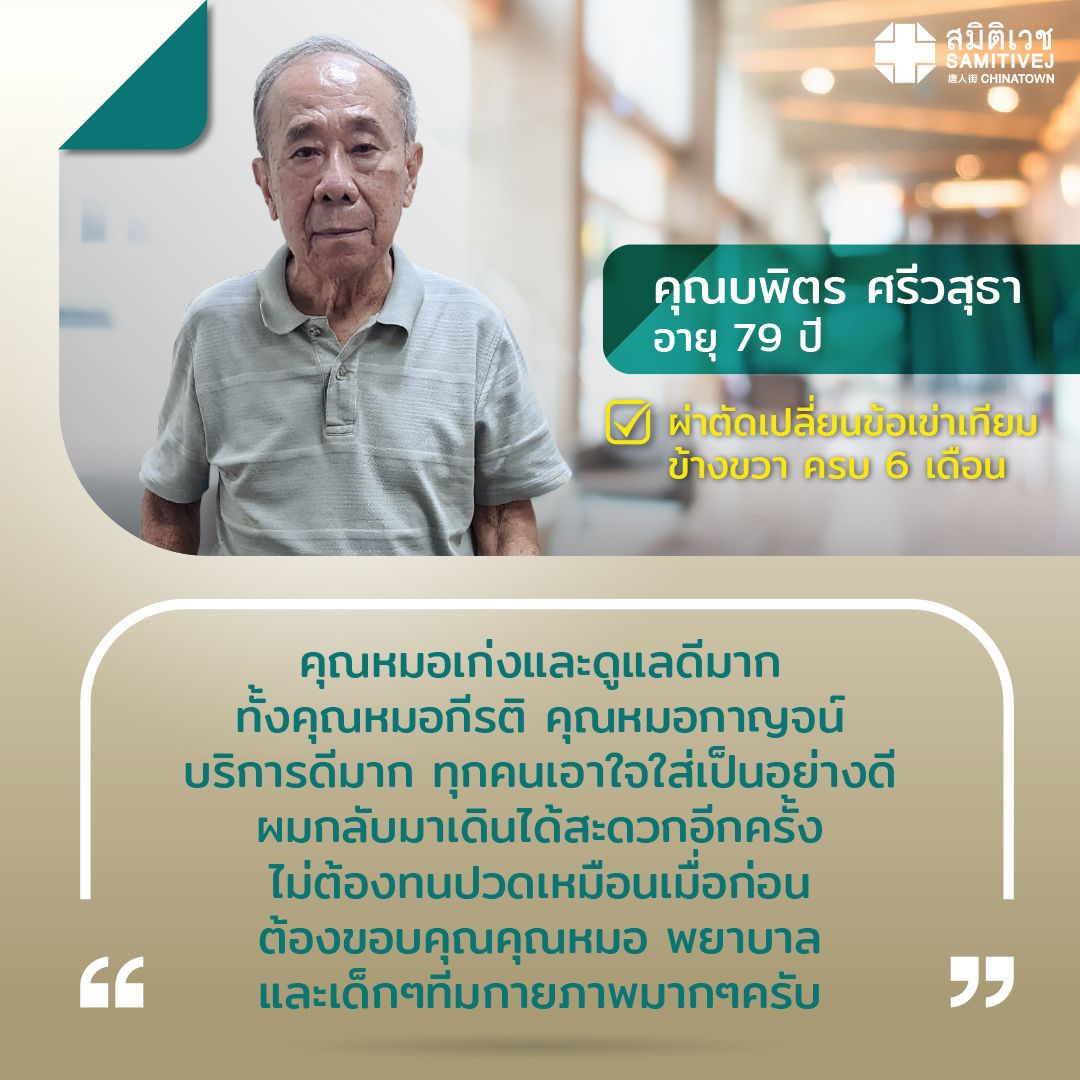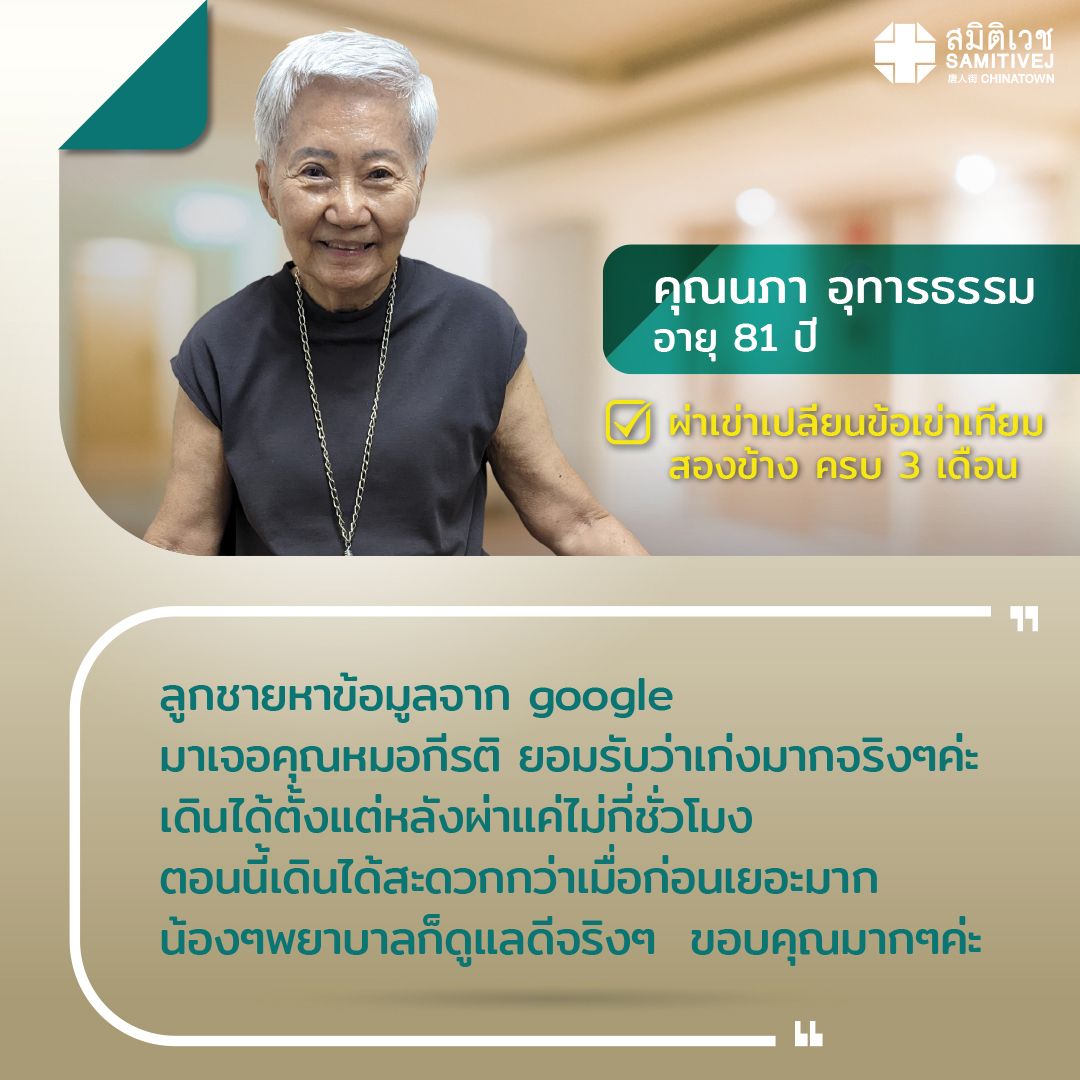

Samitivej Chinatown Joint Replacement Center

Our specialized orthopedic medical center is staffed by a team of highly experienced physicians with advanced expertise in the diagnosis and treatment of degenerative joint diseases, particularly conditions affecting the knees and hips. We provide comprehensive care ranging from diagnosis, medication, and physical therapy to surgical treatment, including total knee replacement for severe knee osteoarthritis and hip replacement surgery for hip osteoarthritis or trauma-related conditions affecting the knee and hip joints.
Why Choose Samitivej SMART Joint Center
At Samitivej Chinatown Joint Replacement Center, we provide professional orthopedic and joint care services in accordance with international standards. Our approach to patient care is guided by the following key principles:
We prioritize the highest standards of patient safety throughout every stage of care.
Patients are cared for by a multidisciplinary team of specialists, ensuring comprehensive management across all aspects of treatment.
We utilize advanced medical technologies and treatment approaches to address a wide range of orthopedic conditions, including complex joint problems.
We place strong emphasis on post-operative rehabilitation, focusing on muscle and joint recovery to support optimal treatment outcomes and help patients regain mobility.
We provide comprehensive joint care that includes patient education, lifestyle modification, and an integrated approach to treatment, combining both pharmacological and non-pharmacological therapies.
-
Genetic factors and congenital abnormalities, such as leg or knee deformities, may contribute to the development of knee osteoarthritis.
-
Aging reduces the ability of cartilage to repair itself. In addition, women over the age of 50 are more likely to develop knee osteoarthritis than men in the same age group.
-
Being overweight or having a body mass index (BMI) greater than 23 kg/m² can increase stress on the knee joints and contribute to the development of knee osteoarthritis.
-
A history of knee injury may increase the risk of developing knee osteoarthritis, for example:
-
The knee joint may not regain its previous strength or fully recover after an injury.
-
The knee injury may have been improperly treated.
-
-
Repetitive overuse of the knee joint or certain postures that require excessive knee bending, such as kneeling or squatting, can place prolonged or frequent excessive pressure on the knees, increasing the risk of knee osteoarthritis.
-
Inflammatory joint diseases, such as rheumatoid arthritis and gout, can lead to progressive cartilage damage. As the cartilage wears away, patients may subsequently experience joint pain and stiffness.
Symptoms of Knee Osteoarthritis
- Pain around the joint, especially knee pain or joint pain that becomes more noticeable during movement
- A cracking, popping, or grinding sound in the joint during movement
- Bowlegs, knock knees, or deformity of the leg or knee, where the knees may turn inward or outward abnormally
- The leg may rotate outward or inward
- Unequal leg length
- Limited range of motion in the knee or hip, with difficulty fully bending or straightening the joint
- Difficulty sitting down or standing up, a catching or locking sensation in the joint, and difficulty going up or down stairs
Stages of Knee Osteoarthritis
Treatment of Knee Osteoarthritis
- Lifestyle modification, such as adopting a healthy diet, weight control for patients who are overweight, and regular low-impact exercises, such as swimming, cycling, or walking, to help strengthen the knee joints.
- Medication to relieve symptoms, such as pain relievers and non-steroidal anti-inflammatory drugs (NSAIDs).
- Intra-articular hyaluronic acid injection, which may be considered in patients with mild knee pain and less severe cartilage damage.
- Corticosteroid injection, which may be considered for occasional episodes of severe acute pain and inflammation.
- Physical therapy for the knee joint
Non-Surgical Treatment Programs

Hyaluronic Acid Injection Therapy
- Patients with early to moderate knee osteoarthritis
- Patients whose symptoms have not improved despite taking pain relievers or anti-inflammatory medications in combination with physical therapy
- Patients who are not suitable candidates for total knee replacement surgery
- Currently, only one injection per knee is required. The treatment effect may last approximately 6–12 months, depending on the severity of joint degeneration in each individual patient.
Price: THB 22,000 per injection
Remark: The physician will determine the most appropriate treatment approach for each patient based on their individual symptoms and clinical condition.
Corticosteroid Injection Therapy
Corticosteroids are highly effective anti-inflammatory medications that can help relieve pain rapidly. However, they may have potential side effects, including an increased risk of cartilage damage. Corticosteroid injections may provide the following benefits:
- Corticosteroid injections can help reduce pain, swelling, and inflammation, while improving knee joint function in the short term.
- This treatment should be considered only for patients with acute inflammation of the knee joint, significant joint effusion, or limitations that make total knee replacement surgery unsuitable.
- Long-term or repeated intra-articular corticosteroid injections may have adverse effects on the articular cartilage. Therefore, this treatment should be administered under the supervision of a specialist physician.
- Intra-articular corticosteroid injection may be considered for patients with moderate to severe knee osteoarthritis. One injection may be used for both knees, and the treatment effect may last approximately 6 months, depending on the severity of joint degeneration in each individual patient.
Price: THB 3,000 per injection
Remark: The physician will determine the most appropriate treatment approach for each patient based on their individual symptoms and clinical condition.



Total Knee Replacement Surgery

Total Knee Replacement Surgery (TKR) is performed for patients with advanced knee osteoarthritis, particularly those with significant symptoms such as bowleg deformity or limited ability to fully bend or straighten the knee. These symptoms may affect the patient’s quality of life and daily activities, especially when they can no longer be effectively managed with non-surgical treatment options.
Remark: The physician will determine the most appropriate treatment approach for each patient based on their individual symptoms and clinical condition.
Who Should Consider Total Knee Replacement Surgery?
- Severe knee pain that interferes with daily activities, such as significant pain while walking, going up or down stairs, standing up, sitting down, or pain that occurs during sleep.
- Frequent and persistent knee inflammation, including swelling, redness, or chronic inflammatory symptoms around the knee joint.
- Knee deformity, such as bowleg deformity or inward angulation of the knee.
- Difficulty moving the knee, including limited ability to bend or fully straighten the knee.
- Reduced effectiveness of other treatment options, such as oral medications, intra-articular injections, or physical therapy.
Preoperative Assessment and Physical Examination
Recommended Preoperative Assessments Before Total Knee Replacement Surgery Include:
- Comprehensive health assessment to evaluate the patient’s overall health and determine whether they are fit for surgery. The specific tests may vary depending on the physician’s recommendation.
- Knee function assessment, including evaluation of knee movement, the strength of the muscles around the knee, and the stability of the surrounding ligaments.
- Knee X-ray to assess the extent of joint damage.
- Additional investigations, such as blood tests, special X-ray imaging, or MRI, may be performed to evaluate the condition of the muscles and surrounding soft tissues around the bone.
Remark: More than 90% of patients who undergo joint replacement surgery experience reduced pain and are able to return to daily activities with a level of function close to normal.
Preparation Before Surgery
- Evaluation by an internal medicine physician to assess the patient’s overall readiness for surgery. In some cases, further evaluation by a specialist, such as a cardiologist, may be required.
- Laboratory and diagnostic tests, such as blood tests, urine tests, and X-rays, may be performed as part of the preoperative assessment.
- Preparation of the surgical site, including examination of the skin around the knee and leg. If there are signs of skin inflammation, abnormal redness, or swelling, the surgeon will need to reassess the patient before proceeding with surgery.
- Blood preparation may be required, as total knee replacement is a major surgical procedure and may involve significant blood loss. Blood transfusion may be needed during or after surgery. Patients may use blood prepared by the hospital, or they may donate their own blood in advance for use during surgery. Autologous blood donation should be done approximately 3–4 weeks before surgery, with the final donation completed at least 2 weeks prior to the operation.
- Current medications must be discussed with the physician. Patients should inform their doctor about all medications they take regularly. Certain medications may need to be discontinued before surgery, especially those that affect blood clotting, such as aspirin and some anti-inflammatory medications.
Postoperative Care and Recovery
- Install grab bars in the bathroom to assist with walking, standing up, and sitting down safely.
- Check stair railings to ensure they are strong, stable, and secure.
- Prepare a plastic chair for showering to allow the patient to sit safely while taking a shower.
- Arrange for the patient to stay on one floor, especially in multi-storey homes, to avoid going up and down stairs, which may place additional stress on the knee joint.
Our Treatment Programs
|
One-Knee Total Knee Replacement Package
|
|
|---|---|
|
Implant
|
|
|
Standard Room 4 Nights, Nursing, Room Service and Medical Equipment. The package includes 3 meals per day
|
|
|
Medicine, Medical Equipment/Supplies at Ward
|
|
|
Operating Room, Recovery Room, Medicine, Medical Equipment and supplies in OR
|
|
|
Rehabilitation Service
|
|
|
Surgeon and Anesthesiologist Fee
|
|
|
Price: 220,000
|
|
Remark
- The package price does not include preoperative preparation expenses.
- This package is available from today until 31 December 2022 only.
- This price is applicable to Thai nationals only.
- The hospital reserves the right to change prices and conditions without prior notice.
- This package is available exclusively at Samitivej Chinatown Hospital, located on Yaowarat Road, near Odeon Circle.
- For more information, please contact our direct line at 02-118-7893 or the Orthopedic Department direct line at 02-118-7922.

Transforming Patients’ Quality of Life After Treatment